
Fraumünster Zürich: Chagall Windows, Crypt and What to See
The Fraumünster is the church on the west bank of the Limmat in Zürich's Old Town, and its five tall Chagall windows in the choir are the reason most visitors step inside. The entrance is on Münsterhof, the square just off Stadthausquai, and the whole visit fits comfortably into a morning or afternoon. The church faces the Grossmünster across the river, so the two are natural halves of one walk.
What the Fraumünster is and where it sits
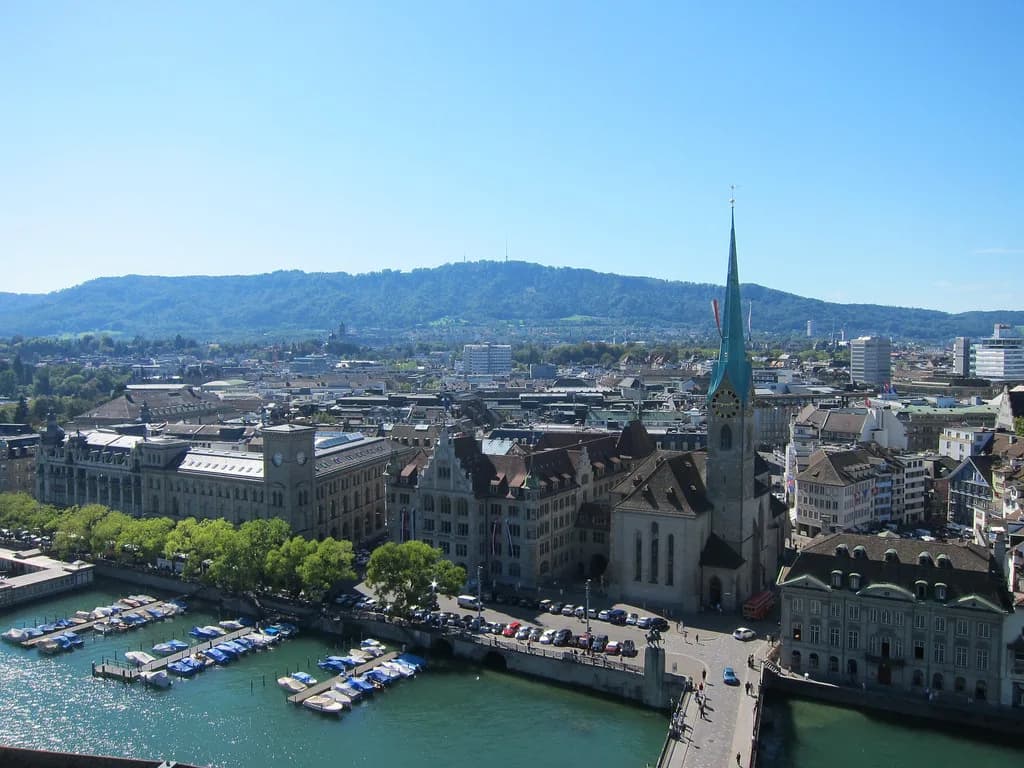
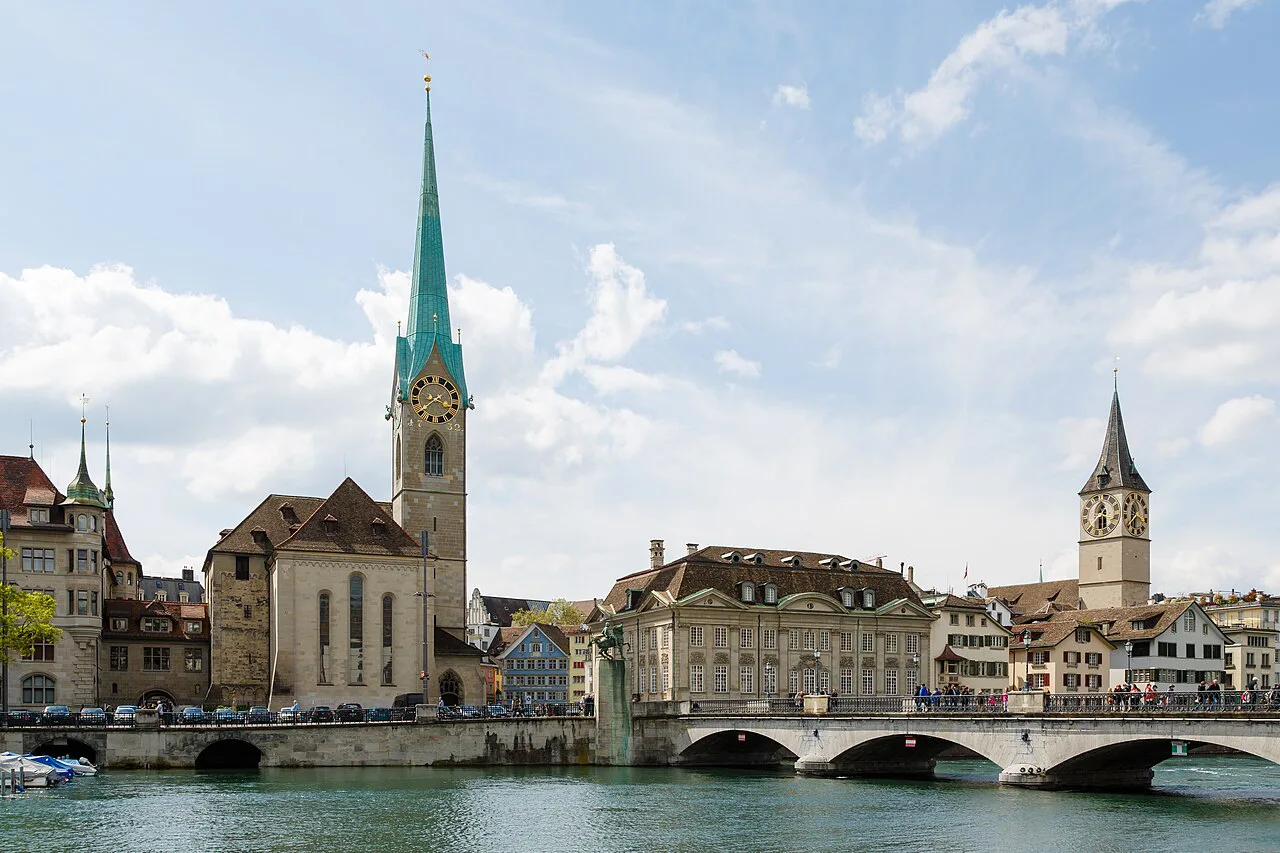
The Fraumünster stands at Münsterhof in Zürich's Old Town, on the west bank of the Limmat, with its address given as Stadthausquai 19. It began in the 9th century as a women's monastery, and the Romanesque choir and Gothic transept still shape the interior. Its green steeple is one of the landmarks you pick out first when you walk along the river.
The abbey's early history is what gives the building its weight: the convent held market, toll and minting rights in medieval Zürich, which made its abbess a genuine power in the city. That context is worth knowing before you look at the windows, because the crypt below the choir displays the oldest surviving stretches of the abbey walls. Treat the church as a historic building with modern glass rather than a gallery.
Zurich Attractions: 8 Visitor Guides is the place to sort the Münster pair from the city's larger museums before you commit a day to them. One church on each bank is a half-day; adding a museum turns it into a full one. The Fraumünster works best as a focused stop, not a destination you build a day around.
Getting there and finding the Münsterhof entrance
Aim for Münsterhof rather than the river frontage. The square is the historic main square of medieval Zürich, directly in front of the church, and it is where you actually go in. If you arrive along Stadthausquai on the water side, walk around to the square instead of hunting for a door on the embankment.
On foot, the church is a short walk from Zürich Hauptbahnhof through the Old Town, and the same walk passes Bahnhofstrasse in Zürich if you start from the station's south side. Trams run along the Limmat quays, and you want a stop on the west bank close to Stadthausquai or Paradeplatz rather than anything across the river. Check the current network map for the stop closest to your starting point.
The five Chagall windows in the choir
Five tall, narrow stained glass windows by Marc Chagall fill the choir, each in its own dominant colour and each built around a biblical theme, running from the Jacob window to the Christ window. They are the centre of the visit and the reason to time your entry for daylight rather than a late evening. Give them the bulk of your indoor time.
Read them as a cycle rather than five separate pictures. The colours shift across the group, and standing at the choir entrance first, then walking closer, shows the sequence better than starting at one end. If the church is busy, wait for a gap rather than viewing over shoulders.
Chagall's rosette and the Giacometti window
The choir is not the whole glass story. Chagall's rosette sits in the southern transept, and Augusto Giacometti's stained glass fills the north transept window opposite. Do not leave after the choir without turning round for both; visitors who count only the five choir windows miss half the scheme.
The pairing is a useful art history lesson in one room: Chagall's dense, saturated narrative glass on one side, Giacometti's abstract colour on the other. The Münster pair is not the only church worth your time in the city, and Grossmünster Zurich across the water carries the Reformation story on the east bank. Ten minutes in each transept here is enough.
The crypt museum under the choir
Steps below the choir lead to the crypt, the oldest surviving part of the church, where a multimedia exhibition traces more than 1,200 years of Zürich's city and church history from the founding of the abbey through the Reformation to the present parish. Archaeological finds and animations show how the monastery was built in phases. Budget around 30 minutes.
The crypt is included in the entrance fee, so there is no separate ticket decision to make once you are inside. The Reformation section gives the building its point: the convent's power was dismantled, and the church became what it is now. Read the labels rather than skimming the cases.

The cloister frescoes and Münsterhof square
The cloister connecting the Fraumünster with the Stadthaus holds a fresco cycle by the Zürich painter Paul Bodmer depicting the church's founding legend, and both the cloister and the cathedral courtyard are freely accessible. That makes the cloister a sensible stop even if you decide against a ticket. It also gives you a quiet covered walk when the square is crowded.
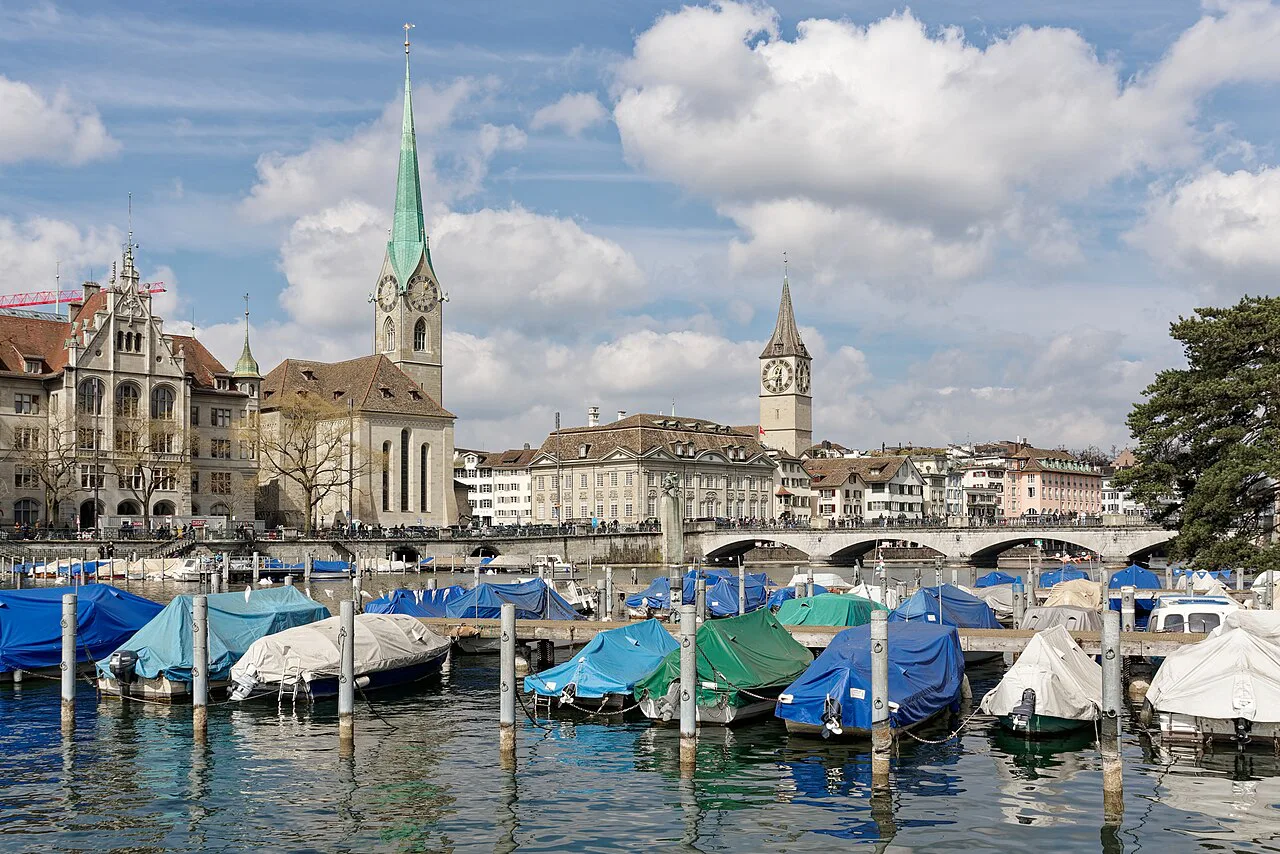
Münsterhof itself is the historic main square of medieval Zürich, and from the Münsterbrücke you get the classic view over the Limmat to the Grossmünster. The bridge is the hinge of an Old Town loop: church, bridge, opposite bank. Save the square for after the interior so you are not doing the history twice.
How much time to allow
Plan on 30 to 45 minutes for the stained glass by Chagall and Giacometti and about 30 minutes for the crypt museum, which puts a comfortable visit at roughly an hour and a quarter without the square. Add 15 minutes for the cloister and Münsterhof and you have an hour and a half, which is the honest figure for a first visit.
If you are short of time, the choir windows are the priority and the crypt the thing to cut. If you are working through several Zürich attractions, this is one of the shorter stops on the list, so it pairs well with a museum rather than filling a morning by itself.
Photography rules inside the church
Photography without flash and without a tripod is allowed for private purposes. That rules out a monopod or a gorillapod as much as a full tripod, and it means hand-held, high-ISO shooting in low light. Phone cameras cope well; a fast prime lens copes better.
The windows are backlit, so meter for the glass and let the interior go dark, or expose for the stone and accept colour that looks flatter than it does in person. If you want the windows properly, come back when the light is lower and the contrast is easier to handle.

Accessibility and the crypt stairs
Switzerland Tourism describes the Fraumünster as partially accessible, and the crypt specifically as not barrier-free. The steps down to the exhibition are the constraint, so travelers with mobility needs should treat the crypt as optional rather than assumed. The choir and transepts are on the main floor and remain the core of the visit.
The cloister and cathedral courtyard are freely accessible, which gives a wheelchair user a way to see part of the complex even where the interior is difficult. Allow more time than the standard 30 minutes for the crypt if you are managing stairs and narrow cases. Check current access arrangements with the Fraumünster before you travel.
What is nearby: Grossmünster, Münsterbrücke and Lindenhof
The Grossmünster stands directly opposite across the Limmat, and the Münsterbrücke between them is the natural crossing. They were rivals in the medieval city, and seeing both in one walk makes that rivalry concrete. Grossmünster Zurich has its own guide covering what a visit there involves.
Lindenhof Zürich is a short climb up from the west bank and gives you a raised view back over the river and the Old Town roofs, which is a good way to end the loop. From there you can walk down toward Bahnhofstrasse Zürich or carry on into Zurich Neighborhoods for the wider layout of the center.
If you want a third stop on the same day, the Kunsthaus Zürich sits on the east side of the Old Town and extends the art thread begun by the windows. Build a 3 Days in Zürich plan around the Münster pair on day one and the museums later, so the churches do not compete with a big collection.
Practical tips before you go
Opening hours, ticket prices and any service times are not fixed here; the church publishes current visitor details on fraumuenster.ch, and that is where to confirm the day you plan to go. Bring cash or a card and expect to pay at the door rather than booking far ahead. Sunday visits can coincide with services, so check before turning up mid-morning.
Read the windows before you arrive or pick up the leaflet inside; the biblical themes are not obvious from the glass alone. If churches are one part of a broader city break, Things to Do in Zürich puts them alongside the rest of the center. Keep the visit compact and you will enjoy it more.
Plan Your Visit
The Fraumünster is a 90-minute stop built around five Chagall windows, a Giacometti window and a crypt that explains how the convent shaped medieval Zürich. Go for the choir first, the transepts second and the crypt third, then cross the Münsterbrücke to the Grossmünster to complete the pair.
Confirm the day's opening hours and ticket price on fraumuenster.ch, since they are not fixed here, and remember the crypt has stairs and is not barrier-free. The cloister and square cost nothing and are worth fifteen minutes on their own.
Explore more Zurich guides
Frequently Asked Questions
What is the Fraumünster in Zürich known for?
It is known above all for five tall stained glass windows by Marc Chagall in the choir, each with its own colour and biblical theme. A rosette by Chagall in the southern transept and a window by Augusto Giacometti in the north transept complete the glass, and a crypt museum below the choir covers more than 1,200 years of city and church history.
How long does a visit to the Fraumünster take?
Allow 30 to 45 minutes for the Chagall and Giacometti windows and around 30 minutes for the crypt museum, which comes to roughly an hour and a quarter. Adding the cloister and Münsterhof square brings it to about an hour and a half, which is a realistic first visit.
Can you take photos inside the Fraumünster?
Yes, for private purposes, without flash and without a tripod. That includes small supports such as a gorillapod, so plan on hand-held shooting in low light. The windows are backlit, so meter for the glass if the colours matter to you.
Is the crypt included in the Fraumünster entrance fee?
Yes. The crypt visit is included in the entrance fee, so there is no second ticket to buy once you are inside. The crypt holds the oldest surviving parts of the abbey walls and a multimedia exhibition on the site's history.
Is the Fraumünster accessible for wheelchair users?
The church is described as partially accessible, and the crypt is specifically not barrier-free because of the steps down. The choir and transepts are on the main floor, and the cloister and cathedral courtyard are freely accessible without a ticket.
Where is the Fraumünster in relation to the Grossmünster?
They face each other across the Limmat in Zürich's Old Town, with the Münsterbrücke connecting the two banks. The Fraumünster entrance is on Münsterhof, on the west bank. Walking between them over the bridge is only a few minutes and makes a natural pairing.