
Schlosskirche Interlaken: A Visit to Interlaken's Castle Church
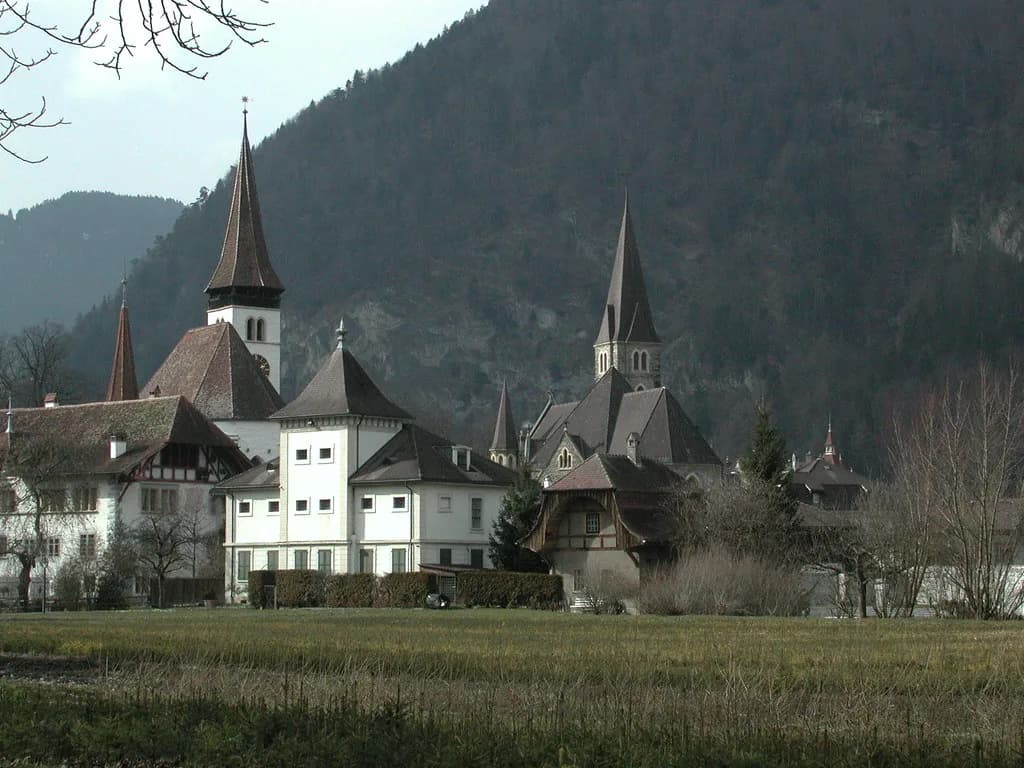
The Schlosskirche is free to enter and sits directly behind the Höheweg and the Höhematte, which makes it the easiest historical stop to add to a walk through central Interlaken. The building began as an Augustinian monastery founded in 1133, and its long, uneven history explains why a fairly plain exterior hides the most interesting parts. Address and entry details are published on the church's own site.
Schlosskirche Interlaken at a Glance
The church stands at Schloss 7 in 3800 Interlaken, a short step off the Höheweg promenade and the open lawn of the Höhematte. Entry is free, so the stop costs nothing beyond your time, and a Sunday service is held at 10:00, which is the moment to plan around if you want quiet rather than company. Outside that service, visiting hours should be confirmed on the Schlosskirche website before you set out.
Treat the Schlosskirche as a 20- to 30-minute stop rather than a half-day sight. The tower is the most striking element from the street, and the real reward is inside, where the choir windows and the scale of the former monastery church reward a slow look. History and architecture enthusiasts will get the most from it; travelers hunting big panoramas should put their time into the mountains instead.
Where the Church Sits in Interlaken
Interlaken splits into two centers, Interlaken West and Interlaken Ost, with the Höheweg running between them. The Schlosskirche sits on the southern side of that promenade, so it works naturally as a pause between a stroll along the Höheweg and a rest on the Höhematte lawn. If you are working out how the town fits together, the area guides break down each quarter, and the Interlaken Neighborhoods guide is the place to start mapping which quarter you will stay in.
The Höhematte is the large open field in the middle of town, and the church stands just behind it. That position makes the Schlosskirche a natural marker on a central loop: promenade, lawn, church, then back onto the Höheweg. Because it is so central, it slots into almost any day without a detour.
Getting There on Foot
Both Interlaken stations are walkable from the church, with the Höheweg providing a straightforward route from either end of town. From the Höhematte the church is a matter of minutes on foot, so no bus or taxi is needed for this stop. Confirm the exact approach on a map before you go, since the entrance sits off the main promenade rather than on it.
A simple plan is to walk the Höheweg from one station toward the other and break the walk at the church. That way the Schlosskirche costs you no extra walking at all. Allow a comfortable half hour including the stop, and more if you like reading into old stonework.
The Monastery Story: 1133 to the Reformation
Otto Seliger von Oberhofen, who also held Oberhofen Castle on Lake Thun, founded the Augustinian monastery here in 1133. A women's convent was added in 1257, and the community became a busy place for unmarried women and their families. Schools for boys and girls operated in the buildings in the later 14th and 15th centuries.
The monastery grew into the largest landowner in the Bernese Oberland during the 14th century, and that power brought friction. In 1494 the pope ordered it closed at Bern's urging, and the Reformation of 1528 closed the church and transferred the monastery's property to the Canton of Bern. This is the break that turned a working religious house into a secular building.

Barrel Shed, Wine Cellar, and Return to Worship
After the Reformation the building served as a barrel and wagon shed, with the cellar used for wine storage. That unglamorous chapter explains a lot about the interior you see now: this was not a church preserved intact through the centuries. A mass was held here again only in 1841.
A dividing wall was removed in 1950, and the church was renovated in the years that followed. That renovation is when the interior gained the character visitors respond to today. Reading the building this way makes the visit more than a quick look at an old tower.
Paul Zehnder's Stained Glass
After the dividing wall came down in 1950, the artist Paul Zehnder was commissioned to design three stained-glass windows for the choir and six more elsewhere in the church. He worked in his workshop in the nearby Isletwald, and the Halter factory in Bern produced the glass. The windows are the centerpiece of a visit, so give them the bulk of your time inside.
Look for the round window among the group, which shows the range of Zehnder's design beyond the choir. Light conditions change how much color comes through, so a morning stop and a late-afternoon stop can feel like different rooms. If stained glass is your reason for coming, plan the visit for daylight hours.
The Tower, the Bells and the Carillon
Four bells once hung in the tower, but from 1538 they were handed on to other churches in the surrounding area. The carillon of four bells heard from the tower today was introduced on 1 August 1926, dedicated to the local dead of the First World War, with the notes A, F, D-flat and E-flat. Treat that as the history of the bells rather than a guaranteed daily performance.
The tower is the one element that stands out from the street, while the body of the church reads modestly from outside. That contrast is the honest trade-off of the Schlosskirche: no grand facade, but a rewarding interior. Set your expectations accordingly and the visit will land well.
Practicalities for Your Visit
Entry is free, the address is Schloss 7, and a Sunday service begins at 10:00. If you plan to attend worship, arrive a little early and keep sightseeing to the hours around it; if you want an empty church for the windows, avoid that slot. Check the Schlosskirche website before making a special trip, since published visiting details beyond the Sunday service can change.
Allow 20 to 30 minutes for the church itself and pair it with a walk along the Höheweg. The visit is free, which makes it an easy addition to a day whose budget is going into mountain transport. Bring nothing special; this is a short indoor stop, not an excursion.

What Is Nearby
The Höheweg promenade and the Höhematte lawn are immediately outside, so the church pairs naturally with a central stroll. For a museum stop of a different kind, the Kunsthaus Interlaken is in the same central area and makes a sensible follow-on for an art-minded afternoon.
Travelers who want local history in more depth can add the tourist museum in town, which covers the resort's own past and its rise as a destination. Together with the Schlosskirche, that gives a compact history half-day without leaving the center. Check each venue's opening days before building the plan.
Nearby Options for the Rest of the Day
The classic Interlaken viewpoint is Harder Kulm, reached by funicular from near Interlaken Ost, and it pairs well with a morning in town. Its terrace looks over the town and the two lakes, so save it for clear weather. For a much higher and colder excursion, the Jungfraujoch railway runs up to the Sphinx Observatory and the Top of Europe station, a full-day commitment rather than an afternoon add-on.
Two more mountain options shape a longer stay: the Schilthorn above Mürren, with its Piz Gloria summit station, and the Schynige Platte Railway from Interlaken Ost, which climbs to an alpine garden with views across the Bernese Alps. Both depend on clear weather and a free day, so treat them as alternatives rather than additions. Check timetables and tickets with each operator before committing.
Plan Your Visit
The Schlosskirche earns its place on a central Interlaken walk because entry is free, the setting behind the Höheweg could hardly be more convenient, and the Zehnder windows give the interior real substance. Go for the history and the glass, keep the stop short, and plan around the 10:00 Sunday service if you want a quiet look.
Before you go, check the church's own website for current visiting hours, then decide whether the stop sits in a town morning or a mountain day. Either way, build the rest of the day around what the weather is doing, not the other way around, and consult our guide to the best time to visit Interlaken when you are weighing which season suits a town-and-mountain plan.
Frequently Asked Questions
Is the Schlosskirche in Interlaken free to enter?
Yes. Entry is free, so the visit costs nothing beyond your time. Any donations or special arrangements are handled on site.
Where is the Schlosskirche in Interlaken?
It stands at Schloss 7 in 3800 Interlaken, directly behind the Höheweg promenade and the Höhematte lawn in the center of town. Both Interlaken stations are within walking distance.
What can you see inside the Schlosskirche?
The main draw is the stained glass by Paul Zehnder, comprising three windows in the choir and six more elsewhere in the church, produced by the Halter factory in Bern. You also see the interior of a former Augustinian monastery church with a long, interrupted history.
When was the Schlosskirche built?
The monastery was founded as an Augustinian house in 1133 by Otto Seliger von Oberhofen, and a women's convent was added in 1257. The building was closed by papal order in 1494, closed again during the Reformation in 1528, and used for decades as a barrel and wagon shed.
Are there services at the Schlosskirche in Interlaken?
A Sunday service is held at 10:00. Treat that as the published time and check the church's website for any change before you travel.
How long do you need at the Schlosskirche?
Plan on 20 to 30 minutes to see the interior and the windows at an unhurried pace. It works best as a stop within a longer walk along the Höheweg and around the Höhematte.