
Chur Cathedral (Cathedral of the Assumption): A Visitor's Guide
Chur Cathedral, the Cathedral of the Assumption, stands on the episcopal court on the rise directly above the old town. The climb is short but real: you leave the lanes below and arrive on a terrace-like court with the church at its center. This guide covers the building itself, what to look for inside and out, and how to pace a visit.
The present church was built over roughly a century, and its fabric mixes Romanesque and Gothic work. The details below come from the city's own listing for the cathedral, which is the place to confirm current visiting arrangements before you set out.
Chur Cathedral at a Glance
Chur Cathedral is a Roman Catholic church dedicated to the Assumption of the Virgin Mary, also known under its German name, St. Mariä Himmelfahrt. It sits at Hof, 7000 Chur, on the episcopal court above the old town. The city's tourism office describes it as one of the most important cultural monuments in Switzerland.
The court around the cathedral is part of the experience, not just the approach. The site was settled in Roman times, when it served as a barracks, so you are standing on layers of the city's history before you reach the church door.
Where It Is and How to Get There
The cathedral stands on the Hof, the raised episcopal court above Chur's old town. The address is Hof, 7000 Chur. From the old town lanes the route is uphill rather than a flat stroll, so build a few minutes of climbing into your plan, especially if you are coming from the lower streets.
If you are arriving from the station side of town, head for the old town first and use its streets to orient yourself before climbing to the court; the cathedral is the landmark above you. The tourism office publishes directions to the cathedral on its listing.
A useful way to structure the walk is to come up through the old town's gate and lanes, which puts the cathedral at the end of a short ascent rather than the start of your day. The Obertor marks one of the old entrances to these lanes.
The Building: 1154 to 1270
The current cathedral was built between 1154 and 1270, and it was dedicated to the Assumption of the Blessed Virgin Mary in 1272. Because Chur lay on major trade routes, the building shows influences from several European traditions rather than a single style.
Several earlier cathedrals stood on the same spot, and the first is thought to date back to the fifth century. The city listing also gives a construction window of 1150 to 1272 in one line and 1154 to 1270 in another; either way, you are looking at a building shaped across the twelfth and thirteenth centuries.
A full restoration ran from 2001 to 2007, so the stonework and interior you see are the result of a recent, thorough campaign. That helps explain how legible the carvings and the high altar are on a visit today.
What to See Outside
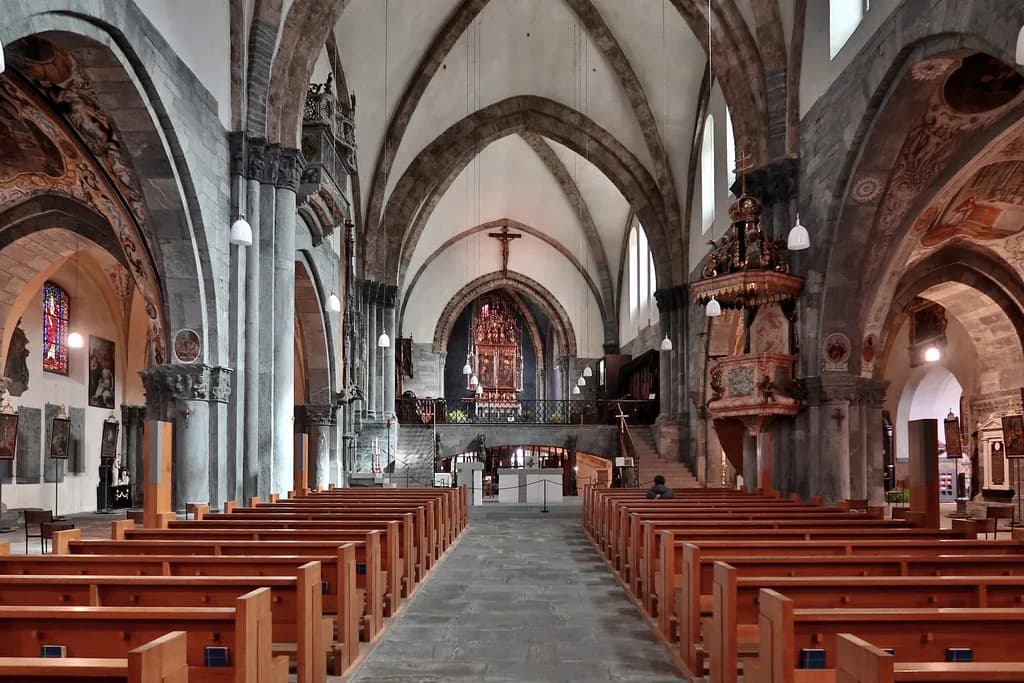
Start with the entrance front of the central nave, which is built of rock from Scalära. Look at the main portal, flanked on each side by six slender columns with Attic bases and early Gothic floral capitals. The columns are connected by six colored archways, a detail worth a slow look before you go in.
Above the portal, on the central axis, sits an arched window described as arguably the largest medieval window in all of Graubünden. Step back across the court to see it in proportion to the facade rather than from directly beneath.
The court itself rewards a few minutes: walk its edges to read the cathedral's position above the old town, then return to the portal. Photographs of the facade work best from the far side of the court, where the window and portal fit in one frame.

What to See Inside
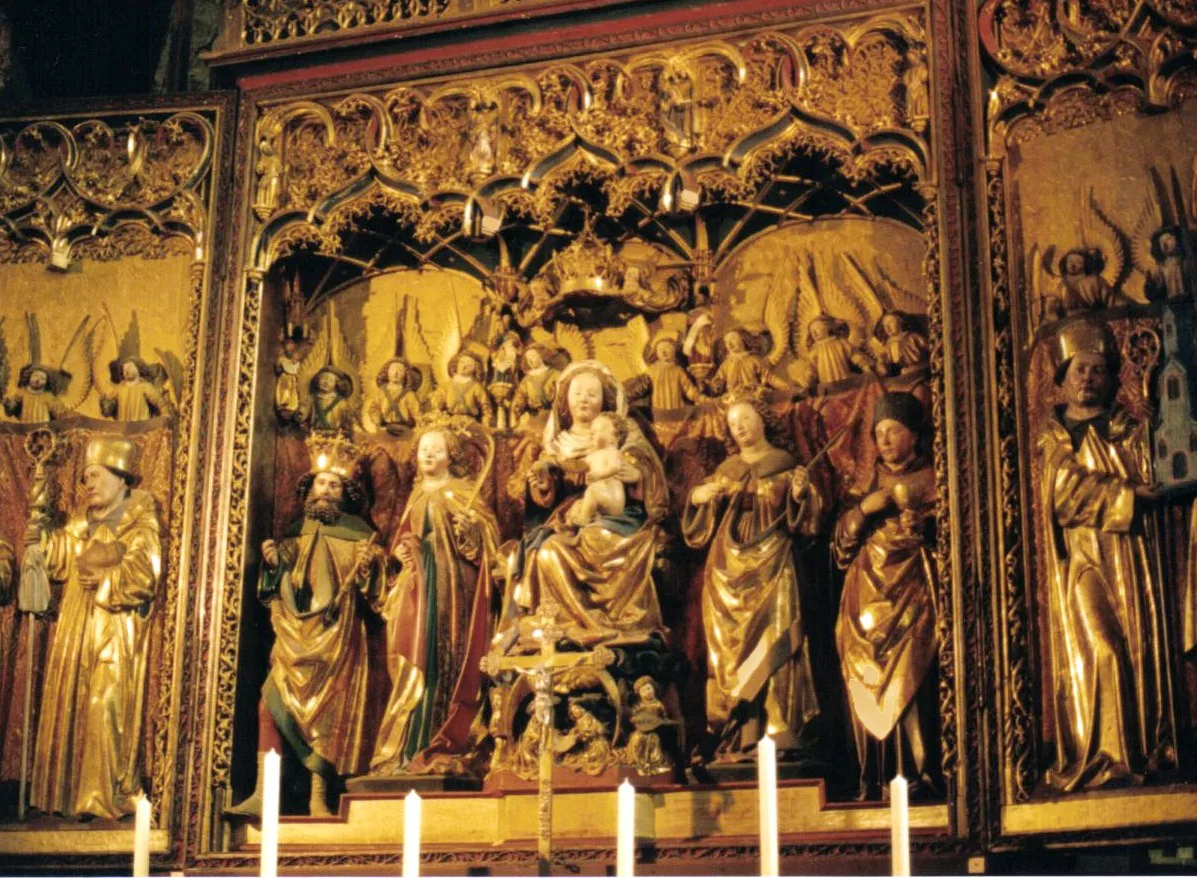
The interior highlight is the late Gothic high altar by Jakob Russ, dated 1492, with a golden splendor that the city listing singles out. It is the piece to seek out first if your time is short.
Beyond the altar, look for the carved choir and the Romanesque sculptures along the bases and capitals of the columns. These carvings sit at eye level and low down, so they are easy to miss if you keep your gaze upward; a slow circuit of the nave catches them.
The mix of Romanesque structure and Gothic furnishings is what makes the interior worth more than a quick glance. If you have an interest in church art, the altar and choir alone justify the climb.
How Long to Allow
About an hour covers the court, the facade, the portal and a careful circuit of the interior. If you linger over the high altar and the column carvings, allow a little more; if you are short of time, prioritize the portal outside and the Russ altar inside.
The visit pairs naturally with the rest of the old town, which is a short descent away. The city's own suggestions for one, two or three days in Chur show how the cathedral fits into a wider stay.

Nearby Sights in the Old Town
Below the court, Chur's old town holds several museums within walking distance. The Rätisches Museum Chur covers the region's history and archaeology, and the Bündner Kunstmuseum Chur concentrates on art from Graubünden and beyond.
For a quieter pause after the climb, the Fontanapark offers a formal garden setting in the city. It makes a calm contrast to the stone of the cathedral and the bustle of the lanes.
If you are comparing cathedrals across Switzerland, Lausanne Cathedral on Lake Geneva and Lugano Cathedral (San Lorenzo) in the south are useful counterpoints in scale and setting.
Practical Notes Before You Go
The city's listing for the cathedral covers its location and contact details, and it is the place to confirm opening times and any visitor rules for the day you plan to visit.
Because this is an active Roman Catholic church, treat it as a place of worship as well as a monument: keep noise low and be mindful of services if you arrive while one is under way.
Plan Your Visit
Chur Cathedral rewards a focused hour: the Scalära stone entrance front and its six-column portal outside, the Russ high altar and Romanesque carvings inside. Come up through the old town, take the climb at an easy pace, and give the court a few minutes before you go in.
Check the cathedral's own listing for the day's visiting arrangements, then use the rest of your time in Chur for the old town lanes and museums just below the court.
Frequently Asked Questions
Where is Chur Cathedral located?
It stands on the episcopal court, the Hof, above Chur's old town, at Hof, 7000 Chur. The approach from the old town lanes is a short uphill walk rather than a flat stroll.
How old is Chur Cathedral?
The present building was constructed between 1154 and 1270 and dedicated to the Assumption of the Virgin Mary in 1272. Earlier cathedrals stood on the same site, with the first thought to date to the fifth century.
What can you see inside Chur Cathedral?
Look for the late Gothic high altar by Jakob Russ, dated 1492, the carved choir, and the Romanesque sculptures on the column bases and capitals. The recent restoration makes these details easier to read.
How long does a visit to Chur Cathedral take?
About an hour is enough for the court, the facade and portal, and a careful circuit of the interior. Allow more time if church art interests you and less if you focus on the portal and the high altar.
Is Chur Cathedral free to enter?
The cathedral's own listing is the place to confirm current entry arrangements and any visitor rules before you go, since these can change.
What is the high altar in Chur Cathedral?
It is a late Gothic high altar made by Jakob Russ in 1492, noted for its golden splendor. It is the interior piece to seek out first if your time is short.
What is the large window on the cathedral facade?
An arched window on the central axis of the entrance front is described as arguably the largest medieval window in Graubünden. Step back across the court to see it in proportion to the facade.