
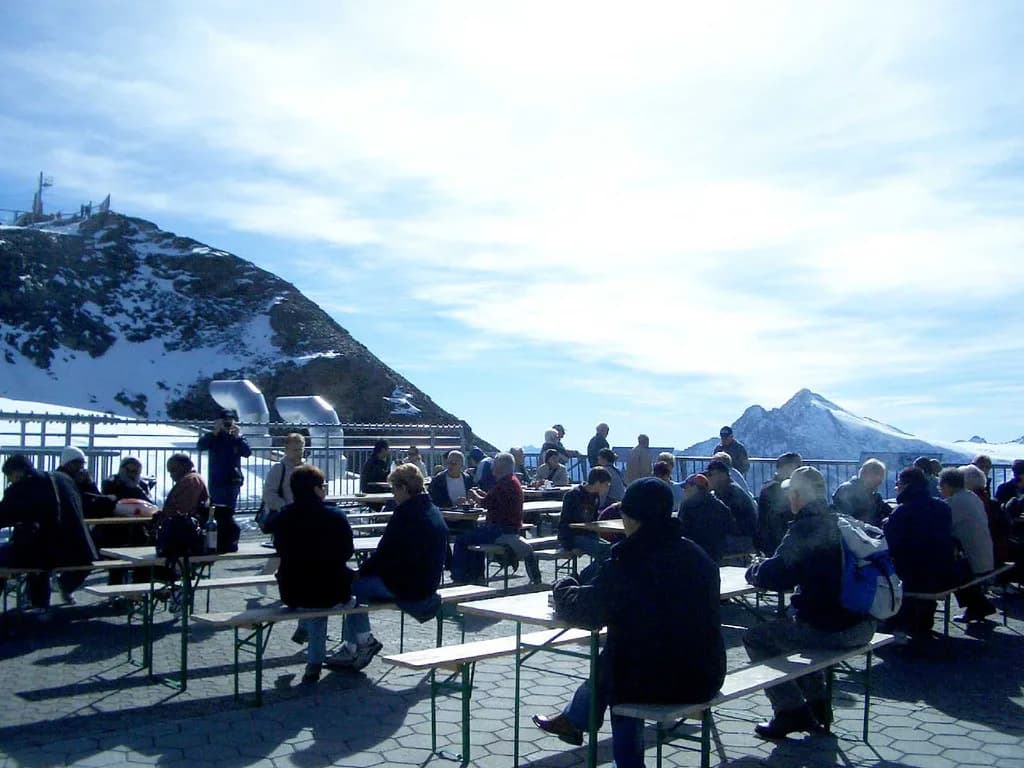
Mount Titlis: A Visitor Guide to the Summit and Glacier
Mount Titlis is a 3,062-meter summit in Central Switzerland, reached from the valley resort of Engelberg. The trip splits into two clear pieces: a train ride from Lucerne, then a 30-minute lift that starts as a gondola and finishes in a rotating cableway cabin. Plan for a half day at minimum, and treat the summit building and the snow attractions as two separate stops so you can skip what does not appeal.
The high point sits on the border between the Obwalden and Bern cantons, roughly 35 kilometers from Lucerne. On a clear day you get a wide mountain panorama, and the glacier zone keeps snow and ice on the mountain through the year. The summit is also wheelchair-accessible, which is worth knowing before you commit to a mountain day.
Where Mount Titlis stands above Engelberg
Engelberg is the base village: everything starts here, with the lift station in town and the summit 3,062 meters above it. From Lucerne the train runs directly to Engelberg, so you do not need a car for the whole trip. The mountain itself lies across the Obwalden and Bern cantonal border, which explains the long ridge views from the top.
Engelberg is a working mountain resort rather than a transport hub, and its compact center means the walk from the station to the lift is short. Build the day around the lift's two stages rather than around town: the village is what you pass through on the way up and back down. If you are weighing Titlis against the Pilatus and Rigi mountains on the other side of Lake Lucerne, Titlis is the higher, glacier-based option and the longest lift ride of the three.
Getting there: train from Lucerne to Engelberg, then the lift
The pattern is simple to plan: take the train from Lucerne to Engelberg, walk to the lift station, and ride two stages to the top. The first stage is a gondola that climbs to the mid-station, and the second is the rotating cabin that covers the final stretch to the summit. The whole lift journey takes about 30 minutes, so the day is dominated by travel up and down rather than by a single sight. If you are still shaping the city half of your trip, a Lucerne itinerary helps you slot this excursion into the right day.
Because the lift runs in stages, you have two chances to stop: the mid-station area for a breather or a view back down the valley, and the summit itself for the attractions. Riders using Swiss public transport can check connections and lift departure times in the official timetable before setting out, since the schedule changes with the season. This is a full mountain excursion, not a stop you can fold into a Lucerne morning of city sights such as the Chapel Bridge.
The ride up: the gondola, then the Titlis Rotair
The Titlis Rotair is the headline piece of hardware: the world's first rotating cableway cabin, which turns a full 360 degrees on its axis as it approaches the summit. It is a short ride, but it means the final climb works as a viewing platform on all sides rather than a fixed window. Riders who expect a long scenic ascent may be surprised that the rotating part is brief and the gondola section carries most of the distance.
Stepping out at the top puts you directly into the summit complex, so the transition from cabin to viewpoint is almost immediate. Go straight to the outdoor deck while the weather is holding, then work back through the indoor options; clouds can close the panorama quickly at this height. Keep the return time in mind too, since the descent eats into summit time more than most first-time visitors expect.
At the summit: TITLIS Tower and the Horizon Deck
The TITLIS Tower is the summit experience built around a Horizon Deck viewing platform, and it also holds casual fine dining and shopping. Treat the deck as the priority and the shops and restaurant as filler for when the cloud comes in. This is where you get the panorama, so budget your clearest hour for being outdoors rather than for browsing inside.
Because the tower concentrates the indoor facilities at the top, it is also the logical place to warm up, eat or wait out a squall between snow activities. Restaurants run along the route as well as at the top, though availability shifts with the season. If your group splits on appetite for cold, the tower gives a comfortable base while others do the outdoor attractions.

TITLIS Cliff Walk, Europe's highest suspension bridge
The TITLIS Cliff Walk is billed as Europe's highest suspension bridge, and it delivers a specific thing: a view of the mountain backdrop from a narrow span rather than from a solid platform. It is the attraction to skip if heights or wind are a problem, and to prioritize if you came for the drama. Allow a short window rather than a long one, since the crossing itself is quick and the queue shapes the experience.
Check conditions before committing to the bridge, because wind and ice can make an exposed span unpleasant even when the summit buildings are comfortable. The glacier setting means snow is present here in seasons when lower Swiss cities are green, so footwear matters more than it would for a town day. Pair the Cliff Walk with the glacier attractions in one outdoor block, then retreat to the tower.
Ice Flyer chairlift over the glacier
The Ice Flyer is an open chairlift that spans ten-meter-deep ice crevasses across the Titlis glacier. It is a different experience from the enclosed Rotair: cold, exposed and much more about looking straight down at the ice. Riders comfortable with open lifts get the closest view of the glacier, while those who are not can stay with the tower and the Cliff Walk.
The glacier cave also sits in the summit zone and is a good swap when wind closes the outdoor lifts. Combine Ice Flyer with the cave and Cliff Walk for a single snow-focused block, then warm up. Because these are open-air attractions, the weather decides the order, not a fixed schedule.
Tickets and discounts with the Swiss Travel Pass and Half Fare Card
Fares are not published in a single place that covers every route and season, so check the current ticket price for your date on the Titlis official website before you buy. The bigger lever is the discount structure: the Swiss Travel Pass (Flex) gives 50% off, the Swiss Half Fare Card gives 50% off, and Interrail gives 25% off. If you already hold one of these, the Titlis day becomes markedly cheaper than a full walk-up ticket.
Book in advance where Titlis Bergbahnen offers it, especially for holiday periods, since lift capacity and preferred time slots fill up on clear days. A rail pass pays for itself over several mountain days, so do the arithmetic across your whole trip rather than for Titlis alone. Travelers comparing peaks should note that Pilatus and Rigi have their own schemes, and a pass that discounts one may treat the others differently; if you are also weighing a city-based stay, the best time to visit Lucerne covers how the seasons shape those mountain days.
When the Rotair cabin is closed and access changes
The rotating Rotair cabin is not guaranteed: it is scheduled to close for maintenance from 17 August to 11 December 2026, with summit access running instead via TITLIS Connect. That is a published window, not a prediction, so plan a visit inside it knowing the ascent will not include the rotating ride. Outside that period, the Rotair normally runs; check the current timetable before you travel.
Lift operations run year-round, which is why Titlis works outside the summer window when other alpine routes close. If the rotating cabin is the reason you are going, pick dates outside the maintenance period; if you mainly want the glacier and the views, TITLIS Connect still gets you to the summit. Build a weather backup into the plan as well, since cloud can cancel the point of the day.

How much time to allow from Lucerne
A Titlis visit from Lucerne is a half day at minimum and easily a full one once you add the train, the 30-minute lift each way, and time at the summit. Do not schedule it between two city appointments: the mountain rewards a relaxed block of three to five hours on top of transport. Travelers with a tight Lucerne itinerary often do better saving Titlis for a day of its own.
Clear mornings are the practical target, because cloud builds at altitude and the panorama is the whole point. If you only have one open day, decide early whether the forecast favors Titlis or a lower alternative such as Rigi, and commit before tickets are bought. Season matters too: the best time to visit Lucerne and its surrounding peaks is worth checking before you lock dates.
What to do nearby in Engelberg
Engelberg is small, so the time around the lift is for a short walk through the village and a meal rather than for a second major attraction. The monastery and the valley floor give a low-key contrast to the ice and steel at the top. Most visitors head back to Lucerne the same day, which keeps the trip to a single clean excursion.
Plan Your Titlis Day
Decide first whether you want the rotating Rotair and the glacier attractions or just the summit panorama, because that choice sets your dates and your budget. Then match a pass to your whole trip, reserve your slot for a clear morning, and allow a generous half day from Lucerne. The result is a mountain day that delivers what you planned rather than a rushed dash between cable cars.
Explore more Lucerne guides
Frequently Asked Questions
How do you get to Mount Titlis from Lucerne?
Take the train from Lucerne to Engelberg, then walk to the lift station and ride two stages: a gondola up to the mid-station and the rotating Rotair cabin to the summit. The lift journey takes about 30 minutes, and the train plus lift together make this a half-day trip at minimum rather than a quick stop.
How much is the cable car to Mount Titlis?
Fares for your travel date are published on the Titlis official website, so price the day there. The discount structure is the practical lever: the Swiss Travel Pass (Flex) and the Swiss Half Fare Card each take 50% off, and Interrail takes 25% off, so check which one you already hold before buying.
Is there snow on Mount Titlis all year?
Yes. The summit sits at 3,062 meters and the glacier zone keeps snow and ice on the mountain through the year, which is why the Ice Flyer chairlift crosses crevasses in the ice and the glacier cave stays part of the summit experience regardless of the season down in Lucerne. Dress for cold at the top even when the city is warm.
What is the Ice Flyer on Mount Titlis?
The Ice Flyer is an open chairlift that spans ten-meter-deep ice crevasses across the Titlis glacier. It is colder and more exposed than the enclosed Rotair, and it gives the closest view down onto the ice. If open lifts are not for you, stay with the TITLIS Tower and the Cliff Walk instead.
How long does a Mount Titlis visit take from Lucerne?
Allow a half day at minimum and easily a full day: the train ride, the 30-minute lift each way and a relaxed block of three to five hours at the summit add up. Do not slot Titlis between two city appointments. Clear mornings are the practical target, since cloud builds at altitude and the panorama is the reason to go.
Is Mount Titlis wheelchair accessible?
Yes, the summit is wheelchair-accessible. The route still involves two lift stages with a change at the mid-station, so allow extra time for the transitions. Check current lift and timetable information before you travel.
Does the rotating Rotair cabin always run?
No. The Rotair is scheduled to close for maintenance from 17 August to 11 December 2026, and summit access runs instead via TITLIS Connect during that window. Lift operations run year-round, so if the rotating cabin is the reason for your trip, choose dates outside the maintenance period.