Best Swiss Chocolate in Switzerland: Brands and Tours Guide
A practical guide to Swiss chocolate: supermarket brands, artisan chocolatiers in Zürich, Geneva and Basel, and factory visits with cited CHF admission prices.
On this page
The best Swiss chocolate depends on what you are actually buying: a supermarket bar for the hotel room, a boxed gift from a city chocolatier, or a half-day at a factory visitor centre where you taste chocolate made on site. Switzerland's milk-chocolate style came from dairy country, and the brands that built it still dominate the shelves. Decide which of those three purchases you want before you compare names.
This guide separates them clearly. It lists the labels you will find in any Coop or Migros, the artisan houses with shops in specific cities, and the four visitor centres that publish admission prices, plus what each ticket includes. Prices come in Swiss francs, and the ones below are the published figures at the time of writing.
What Swiss chocolate means and what to look for on a label
Swiss chocolate's reputation rests on milk. The country's dairy tradition shaped a style where the original bitter cocoa taste was progressively replaced by a creamier, sweeter bar, and that milk-forward profile is what most visitors recognize as Swiss. Dark chocolate with a higher cocoa percentage is the counterweight, and it is where craft makers often put their best work.
What is the most popular Swiss chocolate? Lindt is the best-known brand internationally, and Cailler is the oldest Swiss chocolate brand, dating to 1819. Toblerone is instantly recognizable by its shape.
Which is better, Läderach or Lindt? They are different products. Läderach sells fresh artisan broken chocolate in slabs with toppings such as candied orange and roasted nuts, while Lindt is the familiar wrapped bar and, in Kilchberg, a museum visit.
Why is Swiss chocolate considered good? Swiss makers refined milk chocolate, replacing the original bitter cocoa taste with a creamier, sweeter profile built on the country's dairy tradition. Craft and dark chocolate with higher cocoa percentages now sit alongside that milk-chocolate style.
Cocoa sourcing is the label detail worth reading. Certification marks such as Fairtrade, Rainforest Alliance and Cocoa Horizons indicate third-party verification, and some Swiss makers have used fair-trade cocoa for decades, with Stella Bernrain buying it since 1991. If the box means something to you as a gift, look for a certification mark rather than the Swiss cross alone.
History explains the geography of the industry. The first Swiss-manufactured chocolate went on sale in the 1750s, much of it initially made by French and Italian migrants in Ticino, before manufacturers in the Vaud canton made the treat popular and set up in Vevey, which counted seven chocolate makers by 1806. Knowing that Vevey and the Lake Geneva corridor sit at the center of the story helps when you plan which town's chocolate stop to prioritize.
The brands you'll meet in every supermarket: Lindt, Cailler, Toblerone, Frey, Villars and Kägi
These are the names on every station kiosk and supermarket shelf, and they are the sensible default for everyday eating and small gifts. Lindt is the best-known export and runs its own cocoa sustainability program; Toblerone is recognizable by its Matterhorn-inspired shape and uses fully sustainably sourced cocoa. Cailler is Switzerland's oldest chocolate brand, dating to 1819.
For value, Kägi is the pick for its cult waffles at a moderate price, and Frey offers an extensive range with an emphasis on sustainability. Villars leans on rich, creamy textures with Swiss milk, and Camille Bloch's Ragusa and Torino are the hazelnut-heavy supermarket staples with a strong regional following. None of these need a detour; they are what you buy when you are already in a shop.
Swiss consumption runs high, which tells you how ordinary good chocolate is here: in 2024 the Swiss ate about 10.6 kg of chocolate per person. Treat supermarket bars as the baseline you compare everything else against, not as a compromise.
Artisan and craft chocolatiers: Läderach, Max Chocolatier, Tristan Chocolatier, Camille Bloch
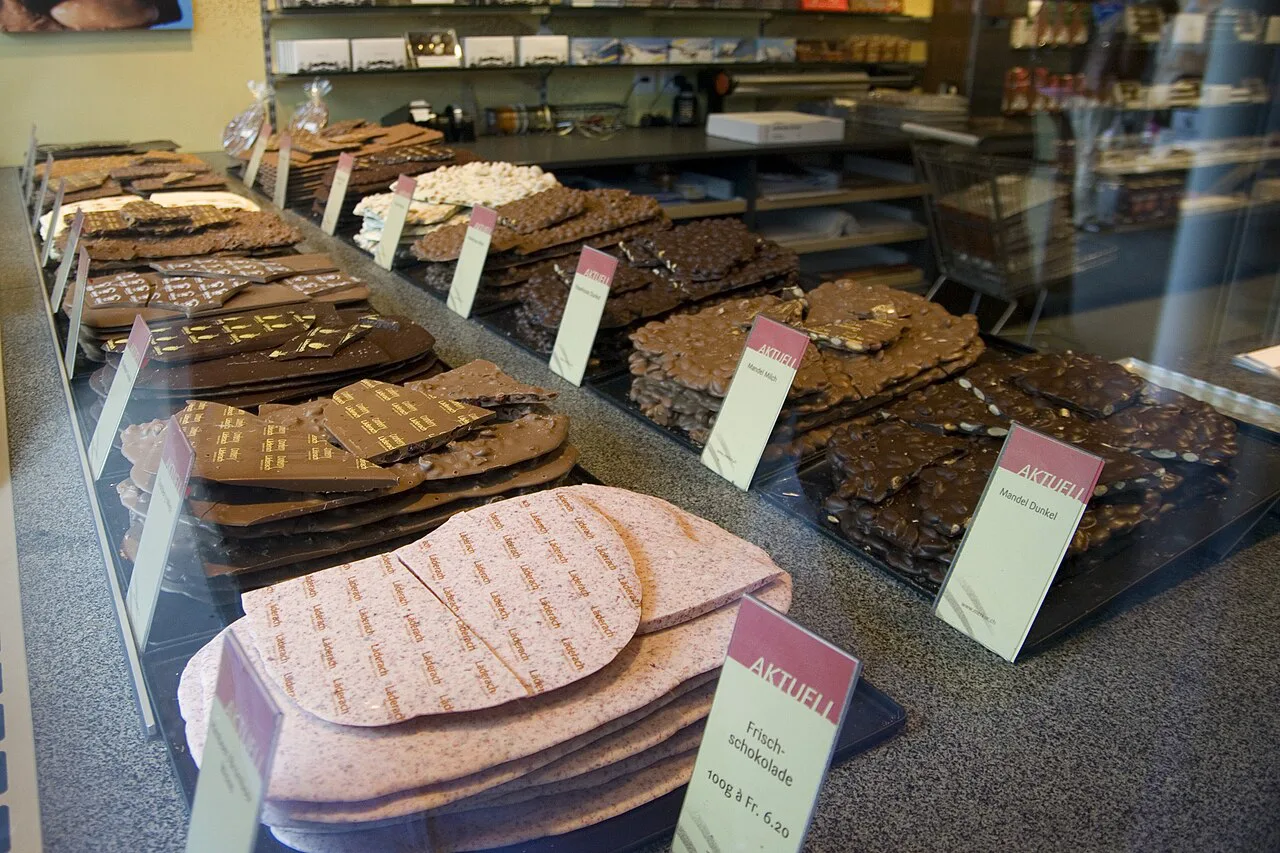
Läderach is the artisan name you will see in city centers, and its fame rests on broken chocolate in slabs studded with candied oranges, caramelized almonds, roasted hazelnuts, cashews, strawberries and pistachios. Buy it by weight in pieces rather than as a wrapped bar, and you get a gift that looks nothing like the supermarket shelf.
Smaller craft houses are where the sourcing conversation gets specific. Max Chocolatier has shops in Zürich and Lucerne, Tristan Chocolatier works from Perroy in the Vaud canton, and Camille Bloch produces in Courtelary in the Bernese Jura. Pairing a shop visit with a city day is the easiest way to buy craft chocolate without adding a separate trip, and our Zürich city guide shows how to build a shop-to-shop walk around a chocolate stop.
If your trip is built around cities, a chocolate stop slots naturally into a walking day: pair a craft shop with the old town rather than treating it as an excursion. Guides to the best cities in Switzerland help you decide which centers give you the most shops within walking distance.
The Geneva chocolate houses: Favarger, La Maison du Rhône, Guillaume Bichet, La Bonbonnière
Geneva has the deepest bench of historic houses. Favarger, founded in 1826, is known for the Avelines hazelnut pralines and the Nougaline, which layers a praline core inside a crunchy nougatine shell under thin milk chocolate. Buy a small assortment rather than a large box if you are carrying it onward in warm weather.
La Maison du Rhône hand-packs its chocolates, while Guillaume Bichet works as both artisan chocolatier and pastry chef. La Bonbonnière, formerly Confiserie Werder, blends traditional methods with a contemporary approach and offers vegan or gluten-free options, which matters if you are buying for a group with dietary restrictions.
Where to buy chocolate in Zürich, Geneva and Basel: Bachmann, Honold, Teuscher, Auer, Stettler, Schiesser, Brändli, Xocolatl
Shop names differ by city, and locals shop accordingly. In Zürich the chocolate shops to know are Bachmann, Honold and Teuscher; in Geneva they are Favarger, La Maison du Rhône, Auer and Stettler; in Basel they are Confiserie Schiesser, Brändli and Xocolatl. Copy that list into your phone before a shopping afternoon.
Shopping runs on Swiss rhythms, so build a chocolate stop into the part of the day when shops are open and keep the museum hours for the rest. If you are weighing how far your budget stretches across a short break, the guide to whether Switzerland is expensive sets out real CHF costs for a city break.
Chocolate travels well as a souvenir, and it fits alongside the other Swiss gifts worth buying, from textiles to paper goods. If your route includes several towns, the most beautiful towns in Switzerland shows which small centers pair a chocolate shop with a walkable old town.
Factory and visitor centres worth planning a half-day around
Five visitor centres publish admission prices and are worth building a half-day around: Maison Cailler in Broc, the Lindt Home of Chocolate in Kilchberg, Camille Bloch in Courtelary, the Chocolarium in Flawil, and Aeschbach's ChocoWelt in Root near Lucerne. Each includes tasting in the ticket. Pick one, not five, unless chocolate is the point of the trip.
Timing matters more than you would expect. Weekday visits at working factories can include a view of production, while weekend visits usually cannot, so check the day before you commit. If a Swiss city break is part of a longer route, the switzerland itinerary shows how a Broc or Kilchberg stop slots into a wider plan.
For a city break of a few days, one factory visit is realistic. The 5 day switzerland itinerary shows where a half-day chocolate stop fits without crowding out the mountains.
Maison Cailler in Broc: price and what the visit includes
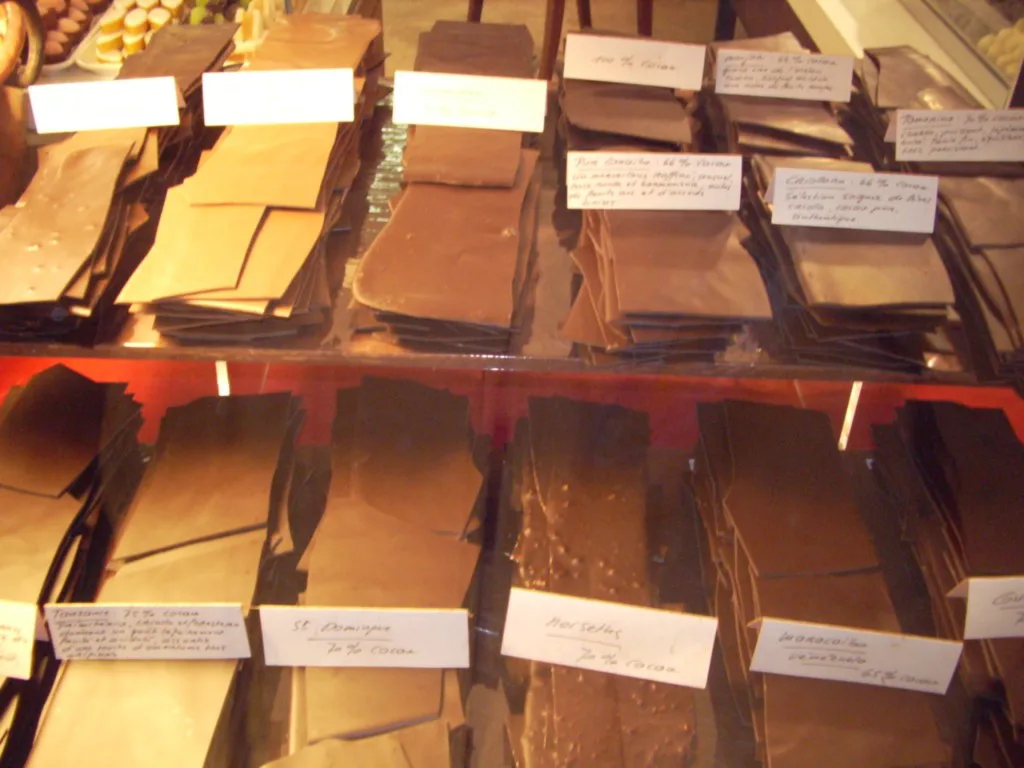
Maison Cailler in Broc, in the canton of Fribourg, runs an interactive tour through the history of the Cailler family business, shows the production line, and ends with an all-you-can-eat tasting room before the shop. Admission is 17 CHF, and holders of a Swiss Travel Pass get in free.
Getting there by public transport means traveling to Bulle and changing to the direct train to Broc-Fabrique, so it pairs naturally with the Gruyère region rather than with Zürich or Lucerne. The house also runs seasonal chocolate workshops in its atelier, which need booking separately. If you are planning a wider rail trip, Switzerland scenic trains offers routes that can connect a Broc visit with mountain panoramas.
Lindt Home of Chocolate in Kilchberg: the fountain, the tasting, the ticket
The Lindt Home of Chocolate opened in Kilchberg in September 2020 around a freestanding chocolate fountain over nine meters tall, with roughly 1.4 tonnes of chocolate circulating through it. Beyond the fountain, the self-guided tour covers chocolate history, a tasting section with Lindor balls and fountain chocolate, and an innovation lab.
Admission is 17 CHF and includes an audio guide plus the tasting stations. Kilchberg is about 20 minutes from Zürich main station by bus or train, or reachable by passenger ship from Bürkliplatz, which makes it the easiest factory visit to bolt onto a Zürich city break.
Tickets can sell out, so book online once your date is fixed rather than arriving and hoping. Allow a couple of hours including the shop, which is enormous.
Camille Bloch in Courtelary: Ragusa and Torino, price and family ticket
The Camille Bloch Visitor Centre in Courtelary covers the family business from its 1929 founding in Bern through wartime shortages, including how Ragusa was created in 1942 when cocoa was hard to source. Live demonstrations show Ragusa being moulded and Torino being piped and coated, with generous samples of both.
Admission is 15 CHF for adults and 9 CHF for children aged 6 to 16, with under-fives free and a family ticket at 40 CHF. A 4D cinema and a scent lab make this the most child-friendly of the visitor centres, and the shop stocks the full range including Pick & Mix.
Courtelary is about 20 minutes by train from Biel, and the visitor centre is a five-minute walk from the station, so it works as a half-day from the Bernese Jura rather than from Zürich.
Chocolarium in Flawil: the happiness factory and watching production on weekdays
The Chocolarium in Flawil is the Maestrani visitor centre for Munz and Minor, built around the question of how happiness gets into chocolate, with interactive stations, a cow-milking simulation and a 100-meter gallery over the production floor. Five chocolate fountains sit in the Room for Individual Happiness.
Production runs Tuesday to Friday, so a weekday visit lets you watch the lines below the gallery; on weekends and public holidays the lines are stopped and screens explain the process instead. Admission is 16 CHF for adults and 9 CHF for children, and a Swiss Travel Pass gets you in free.
Decorating your own bar costs an extra 10 CHF and takes about 20 minutes to cool before you collect it, which is a good souvenir for children. Flawil is roughly 50 minutes from Zürich and 20 minutes from St. Gallen, then bus 741 or 767 to Flawil, Maestrani.
Aeschbach Chocolatier's ChocoWelt in Root near Lucerne
ChocoWelt in Root is Aeschbach's museum, tracing a cacao bean from pod to bar with smell and taste stations and handmade specialties such as Chriesiblüete. On weekdays you can glimpse part of the manufactory through the windows; at weekends the production is closed but screens still show the daily work.
Admission is 17 CHF and includes a 5 CHF voucher for the shop and café, and vouchers from several visitors can be combined. Decorating your own 200 g bar costs 11 CHF extra, and a Sunday chocolate brunch is bookable ahead.
The museum sits next to Root D4 station on the train from Lucerne toward Baar, so it fits a Lucerne day without a car, and Lucerne Chocolate Tour: Which Factory Visit to Pick compares this stop with the city's other options. If you are working out how many days the city deserves alongside a chocolate stop, the Mount Pilatus page shows how a Lucerne day is built, and the best time to visit Switzerland helps you judge which season suits a Lake Lucerne city break.
How to choose: bean-to-bar craft, supermarket value or a factory visit
Choose supermarket brands for everyday eating and lightweight gifts; they cost the least and travel well. Choose city chocolatiers when the gift itself matters and you want something that looks handmade, accepting higher prices per gram. Choose a factory visitor centre when you want an activity with children or a rainy day filled, and expect to pay an admission fee on top of whatever you buy in the shop.
Judge Läderach against Lindt by what you want: Läderach sells fresh artisan slabs by weight, while Lindt is the familiar bar and the Kilchberg experience. Neither is objectively better; the choice is between a gift with texture and variety and a brand you already know.
Bear in mind that brand lists are editorial opinions, and certification labels tell you more about sourcing than any ranking does. Compare the label, not the position on a list.
Practical buying tips: seasonality, carrying chocolate home, and shop vouchers
Chocolate is temperature-sensitive, so buy it late in the trip rather than on day one, and keep boxes out of a hot car or a sunny train compartment. If you are flying home in summer, pack bars in your carry-on rather than checked luggage.
Buy a ticket voucher only if you will use it the same day. ChocoWelt's 5 CHF shop and café voucher comes with the admission ticket, and several visitors' vouchers can be combined at the counter, so a family visit gets more back from the ticket.
Tasting is included at every visitor centre covered here, so eat before you shop and buy only what you actually liked. If you want to time a trip around school holidays or high season, the best time to visit Switzerland lays out what each season means for a city break.
Prices at a glance: entry fees in CHF and how passes change the math
Admission in CHF: Maison Cailler 17; Lindt Home of Chocolate 17; Camille Bloch 15 for adults, 9 for children 6 to 16, free up to five, family ticket 40; Chocolarium 16 for adults and 9 for children, plus 10 to decorate a bar; ChocoWelt 17 including a 5 CHF shop voucher, plus 11 for a 200 g bar. Add the cost of getting there, which for Broc, Courtelary and Flawil is a real train fare.
A Swiss Travel Pass makes Maison Cailler and the Chocolarium free to enter, which changes the math on a rail-heavy trip; check what your pass covers before buying a ticket. If you are still deciding how long to stay, the 7 day switzerland itinerary shows how many half-days a week in Switzerland really holds.
Plan Your Chocolate Stops
Start with the purchase, not the brand: a supermarket bar, a boxed gift from a city chocolatier, or a factory visit with tasting. That decision tells you which of the names above actually belongs on your list.
Then pick one visitor centre and one city shop rather than chasing every factory. Book the ticket online once your date is fixed, go on a weekday if you want to see production, and buy chocolate late in the trip so it survives the journey home.
Explore more Switzerland guides
Frequently Asked Questions
What is the most popular Swiss chocolate?
Lindt is the best-known brand internationally, and Cailler is the oldest Swiss chocolate brand, dating to 1819. Toblerone is instantly recognizable by its shape. Which one is most popular depends on whether you mean sales, recognition or shelf space.
Which is better, Läderach or Lindt?
They are different products. Läderach sells fresh artisan broken chocolate in slabs with toppings such as candied orange and roasted nuts, while Lindt is the familiar wrapped bar and, in Kilchberg, a museum visit. Choose Läderach for a textured gift and Lindt for a familiar bar or the factory experience.
Why is Swiss chocolate considered good?
Swiss makers refined milk chocolate, replacing the original bitter cocoa taste with a creamier, sweeter profile built on the country's dairy tradition. Craft and dark chocolate with higher cocoa percentages now sit alongside that milk-chocolate style.
Which Swiss chocolate factory is worth visiting?
Maison Cailler in Broc, the Lindt Home of Chocolate in Kilchberg, Camille Bloch in Courtelary, the Chocolarium in Flawil and Aeschbach's ChocoWelt in Root all publish admission prices and include tasting. Choose by location and by whether you want to watch production, which is possible at the Chocolarium from Tuesday to Friday and at ChocoWelt on weekdays.
How much does it cost to visit a Swiss chocolate factory?
Published adult admission is 17 CHF at Maison Cailler, 17 CHF at the Lindt Home of Chocolate, 15 CHF at Camille Bloch and 16 CHF at the Chocolarium; ChocoWelt charges 17 CHF including a shop voucher. Check the official page for the site before booking, since family tickets and add-ons such as making your own bar cost extra.
Where can I buy chocolate in Zürich, Geneva and Basel?
In Zürich, shops include Bachmann, Honold and Teuscher; in Geneva, Favarger, La Maison du Rhône, Auer and Stettler; in Basel, Confiserie Schiesser, Brändli and Xocolatl. Each city also has Läderach branches.
Does a Swiss Travel Pass cover chocolate factory entry?
A Swiss Travel Pass gives free entry at Maison Cailler in Broc and at the Chocolarium in Flawil. It is not stated for the Lindt Home of Chocolate or ChocoWelt, so check the official site before relying on it.
Can I carry Swiss chocolate home?
Yes, but treat it as temperature-sensitive. Buy it late in the trip, keep boxes out of a hot car or sunny train compartment, and pack bars in carry-on if you are flying home in summer.
Sources
Notes for your Swiss city break
Optional updates to our Swiss city guides.
You might also like

Continue reading
More guides you'll find useful